Saturday, July 24, 2010

Mentioned in Alex Halperin: Summer in the City


http://www.guernicamag.com/blog/1909/alex_halperin_summer_in_the_ci/

By Alex Halperin

On a Tuesday morning not too long ago, Keith Nelson, co-founder of the Bindlestiff Family Cirkus, left south Williamsburg with a few unicycles in the back of his car. Last fall, Nelson and his friend Rob Hickman, who was in the passenger seat, had been tooling around with their unicycles when they decided to ride over the Williamsburg Bridge. The bridge “is such a focal point in our neighborhood,” Hickman said. The trip “ended up being so much easier than our expectations, our fears, that we decided to then do another couple miles and go to McCarran Park and back.”

Their journey inspired them to unicycle over every bridge in the city. “It seems to make sense. I mean, when we decided to do all the bridges we did not know how many bridges that would entail,” Nelson said. Nelson, who’s forty, wore a straw boater hat and a red t-shirt promoting Hell on Wheel, a Chatham, New York unicycle club. “We counted in our head only twenty or thirty.” They’ve revised their estimate to 2,078. “The ‘why’ is, I think, an evolving question. The idea of spans and connections and what a bridge does both philosophically and architecturally has some kind of interesting flavors for both Rob and I from different angles.” As Nelson drove, he mused, “Most of what’s become boring in New York doesn’t have any bridges. Bridges have always been put where there’s intriguing things happening.”

In rapid succession they checked off the Brooklyn and Manhattan bridges and began the search for the city’s more obscure crossings. “As far as we know, nobody’s compiled a list of every single bridge. Each facet owns some. DoT owns some. MTA owns some. Parks and Rec owns some, but they don’t communicate,” Nelson said. “Most of the bridges that we’re focusing on are water spans but I think the city’s count includes many overpasses and arches and things we didn’t originally think of as a bridge. So we are now documenting those.” There are also sky bridges between buildings. “I have a feeling they’re not in the count at all.” Sky-bridge access might present a problem, he conceded.

Hickman, a sculptor who lined the ceiling of the red line subway stop at 72nd St with more than one million pieces of laminated glass, hopes the bridge tour will evolve into a book or exhibit. He even found an intern for Unicycle NYC Bridge Tour “first of all to figure out where all these bridges are.” They’d discovered about fifty-one bridges in Central Park, considerably more than the city’s count. “There actually used to be a lot more bridges in Central Park but Robert Moses tore a lot down when they brought automobile traffic to the park.”

“Bastard!” Viveca Gardiner, a friend from the New York circus community, cheerfully hissed from the back seat. In blue sunglasses and basketball shorts, Gardiner was the first woman to join the tour’s rotating cast of unicyclists.
“Yeah especially at the northern end,” Hickman added.

“We’re finding throughout the city that Moses really effed it up,” Nelson said.

“The Verrazano was an accomplishment,” Hickman said.

“Yeah he did some cool things,” Gardiner added.

“No not for him, for us,” Hickman countered. “I’m trying to get Keith to do this illegal crossing right now” of the Park Avenue Viaduct. “It goes up on the Grand Central around the Pan Am building or Met Life Building or whatever it’s called.” Debate ensued over whether the Park Avenue Viaduct is a bridge. “We have to do a practice illegal crossing because we’re going to do the Whitestone, that’s gonna be our big one.”

“He’s got that camouflage seat. He’s safe. Nobody’s gonna to see him,” Gardiner pointed out. As the car approached JFK, she spotted the elevated Airtrain track. “Shit, Rob’s looking at it.”

“I bet it has a sidewalk,” Hickman said. “It would be awesome.”

Nelson parked on a quiet street near the airport and the trio pulled their unicycles from the car. Hickman said the trip would be bridges number 126 and 127 and Nelson synced his iPhone to post their route on Twitter. They began weaving through a quiet neighborhood of small, beachy houses. From 101st St they made a left onto 160th Ave. Nelson, who’s something like a professional unicyclist, looked relaxed. He pogoed up onto curbs.

Gardiner’s less experienced. Later, she said when she’s riding, “I’m so exhausted and focused I can’t stop thinking about it for a second.” She described unicycle riding as a constant act of self-correction. “You’re always falling.”

The group approached Ramblersville-Hawtree Memorial Bridge, a road that arced gently over an inlet from Jamaica Bay. Halfway across the bridge Hickman looked at the plaque, which first appeared to read “Pamblersville-Hawtree.” “There’s no cohesive coherent list of bridges in New York City that includes this name. We found this through Google maps.”

As Hickman admired the plaque, Gardiner careened up on her pale green unicycle. “Can you move out of the way please? I’ve gotta make it over a bridge while I’m up.” She reached the far side and lifted her arms in victory. “This is a sweet bridge,” she said. “I love this bridge.”

Copyright 2010 Alex Halperin

Wednesday, June 23, 2010

Hoopla Hoop Article


http://www.hooplahoop.com/2010/06/22/unicycling/

Unicycling
by Dakota Kim

Fourteen guys with hockey sticks are pushing a puck around an empty lot on a moonlit Friday night. It might be a scene just like any other except all 14 guys are on unicycles.

“The skill level is getting to where what we do looks like real hockey,” Jason Kahn, a member of the Hell on Wheel unicycle group, said. “It started out as a way to just do something on the unicycle, and it’s become a real event every Friday.”
Bizarre a sight as they might be at first, the unicycles are coming! With a unicycle festival being organized for this September, unicycle sports gaining new devotees, and clubs forming across the country, unicycling is experiencing a renaissance from its previous heyday of the 50s to the 80s.

No reliable source exists as to where the unicycle was invented, or by whom. A popular theory posits that the pennyfarthing of the late 19th century, a bike with a giant front wheel and tiny back wheel, would often lean forward to the point where the back wheel was off the ground. People started taking the little back wheel off. É voila! A unicycle.

The unicycle has long been a family member of the circus. Though it may have played the funny-looking little sibling to the shining star of the trapeze, everyone from the early to mid-20th century Valla Bertini Troupe to the Ringling Bros. Barnum & Bailey circus has had unicyclists. An especially notable group was the Ringling Bros. Barnum & Bailey’s slam-dunking King Charles Troupe, known as “The Harlem Globetrotters on Unicycles.” Whether riding across a highwire or juggling circles around each other, unicyclists often unexpectedly steal the show.

Michael Richter is one such unicyclist, who received a unicycle as a present when he was 12 and never stopped until he reached the Ringling Bros. Barnum & Bailey Circus as a unicycling clown. Whether leading parades on a 6-foot-tall giraffe unicycle or riding on a highwire, Richter makes it look easy, when in reality, many years of practice have gone into it.

The passion for rolling on one wheel just for fun is particularly vivid in New York. This is a perfect amusement park of a city to unicycle across, under, over and inside of, with all of its public spaces and structures. Half-pipe? Check. Hockey arena? Check. Mountain trails in the outer boroughs? They’re all over that.
 
Mountain unicycling is one of Kahn’s favorites. Kahn, a responsible 8th grade science teacher by day, morphs into a wild unicycler by night, roving around mountain trails and hockey fields.

“You’re using the unicycle as a pogo stick, trying to weave up the trail sideways and hop up onto logs,” Kahn said. “Going downhill, you just kind of let the unicycle run but not too fast or you’ll lose control.”

Riding on a 24-inch-high model with a 3-inch-wide tire with low inflation for better traction and less bounce, mountain unicyclers sometimes even have brakes.

Unicycling seems to have an addictive quality. Once riders get it, they don’t seem to want to stop.
“I’ve been totally obsessed for about a year and a half,” said Keith Nelson, co-founder of the Bindlestiff Family Cirkus. “I had 2 unicycles hanging on the wall for ages and once I started couldn’t stop.”

There is a strong aspect of community for unicyclers, with regular meetings at Grant’s Tomb on the Upper West Side.
“I came for the novelty, in that it’s odd and I find that attractive, but I stayed for the people,” Kahn said. “As a community, it’s very social and non-competitive, not serious and very chill.”

There are steps to mastering this sport, ten skill levels that take you from a 50 meter ride and graceful dismount at Level 1 to being able to do ten types of mounts and riding backward one footed in a figure eight at Level 10.

Kyle Petersen, who performs as a unicyclist at the Brooklyn Cyclones games, started at age 12 and can do tricks from levels five, six and seven.

“I’ve got a pretty decently strong wheel walk, a one-footed wheel walk, I can jump rope, and I can do a lot of tricks that are combinations, such as wheel walking while juggling,” Petersen said. “Pirouettes are what I’m getting into right now, but the problem is I get very dizzy.”

Kahn is working on his hopping, trying to get over large obstacles on the trail while mountain unicycling. “I tend to ride over things better than I hop over them,” Kahn said. “With hopping, you got to jump, land and stand still, then hop again. More than three hops and you lose your center of balance.”

As for distance rider Nelson and trick rider Richter, synchronized pairs figure unicycling is a goal. While it might never become an Olympic sport, the process has been “similar to pairs ice skating or a circus bike,” Nelson said.

“When you have two or more unicycles, you get to do tricks together such as grabbing hands and spinning in a pinwheel, or if we held onto each other in a certain way, we can stand totally still without rocking back and forth, and someone could sit on our shoulders or do some acrobatics off of us,” Richter said. “It more than doubles the amount of tricks we can do. It’s a cross between dance and partner acrobatics.”

There are so many more types of unicycles than imaginable. From ultimate wheels with no seat post, to impossible wheels with two platforms so that you jump on and balance, to giraffe unicycles that are 6 feet high, there are so many more ways to unicycle than there used to be, indicating a rising level of interest.

“The numbers of people are going to go up,” Petersen said. “People have a lot of preconceived notions about what they can and cannot do. Once you see people doing it, you think you can.”

Distance riding is becoming a new challenge, as long amounts of riding can be painful and exhausting on the core and the crotch alike.

“I’ve been totally obsessed for about a year and a half,” said Keith Nelson, co-founder of the Bindlestiff Family Cirkus. “I had 2 unicycles hanging on the wall for ages and once I started couldn’t stop.”

Nelson and Robert Hickman, a sculptor and art professor at Hunter College, have decided on a new challenge to try to unicycle all the bridges in New York.

“We thought that would be 70 or 80 bridges, a one year project,” Nelson said.

There are 2,078 bridges in New York City.

“This includes Department of Transporation and MTA bridges and ones that span roadways as well as water,” Nelson said. “We are going to start crossing skybridges as well, which are bridges that connect buildings.”

It all depends on what you call a bridge, but if that includes anything that goes over a road, railway, body of water or even a footpath, the project will take much more than a year.

“It’s fun because it’s like collecting,” Hickman said. “Every bridge is unique and we take a lot of notes, video and photographs, which we blog about at http://unicyclenycbridgetour.blogspot.com/.

“We’re even going to ride across some of the skybridges at Hunter College, and involve my students in a public art project,” Hickman said. “In a way, a unicycle is a moving public sculpture, a roving public art project.”

As part of the quest, the group recently rode in the 5 Boro Bike Tour, which is the only legal way to cross the Verrazano Bridge. The group has also gotten big cheers from the Hasidic community in South Williamsburg, where public opinion of bikers has been less than positive.

“It’s a very disarming vehicle. Bikes and cars yell at each other, but the unicycle charms everybody,” Hickman said. “The Hasidic community is pro-unicycle, and we want to try to get some of them riding unicycles if we can.”

Hickman sees the potential for community outreach and public art through the unicycle.

“I’d like to reach out to the communities we ride through, such as Flushing, where hundreds of guys came out in front of shops to cheer us on,” Hickman said. “I can see us doing youth programs, teaching kids to ride.”

“We thought that would be 70 or 80 bridges, a one year project,” Nelson said. There are 2,078 bridges in New York City. As part of the quest, the group recently rode in the 5 Boro Bike Tour, which is the only legal way to cross the Verrazano Bridge.

So how do you find your very own unicycle and join in? There are many manufacturers and types, depending on your goals. According to Nelson, Nimbus offers reasonably priced unicycles in many wheel sizes, Semcycles are great unicyclist-designed freestylers, and Koxx makes good trial, stunt and mountain unicycles. According to Petersen, Dube Juggling may be one of the only brick and mortar shops in Manhattan where you can just walk in and buy a unicycle.

In an age of increasingly complicated machinery, the unicycle is a simple machine that inspires cult-like fervor for perhaps the same reasons as fixies.

“The unicycle is basically a completely stripped down bike, no frills,” Petersen said. “This machine basically does whatever you tell it to. If the wheel goes a little faster, you have to shift your weight a little forward a little faster. Every action has an equal and opposite reaction. On a bike, I think the bike is doing all the work, and it’s boring. The unicycle is really kind of very zen, and because you’re concentrating so hard, it’s very relaxing and very peaceful.”

For more information on unicycling, please visit these sites:
New York Unicycle Festival
USA Unicycle Society of America
Uni Magazine
Dube Juggling
unicycle.org
newyorkunicycle.com

Tuesday, June 22, 2010

#154 East 177th Street Overpass over Metro-North RR


East 177th Street Overpass over the Metro-North RR, Bronx, June 22, 2010
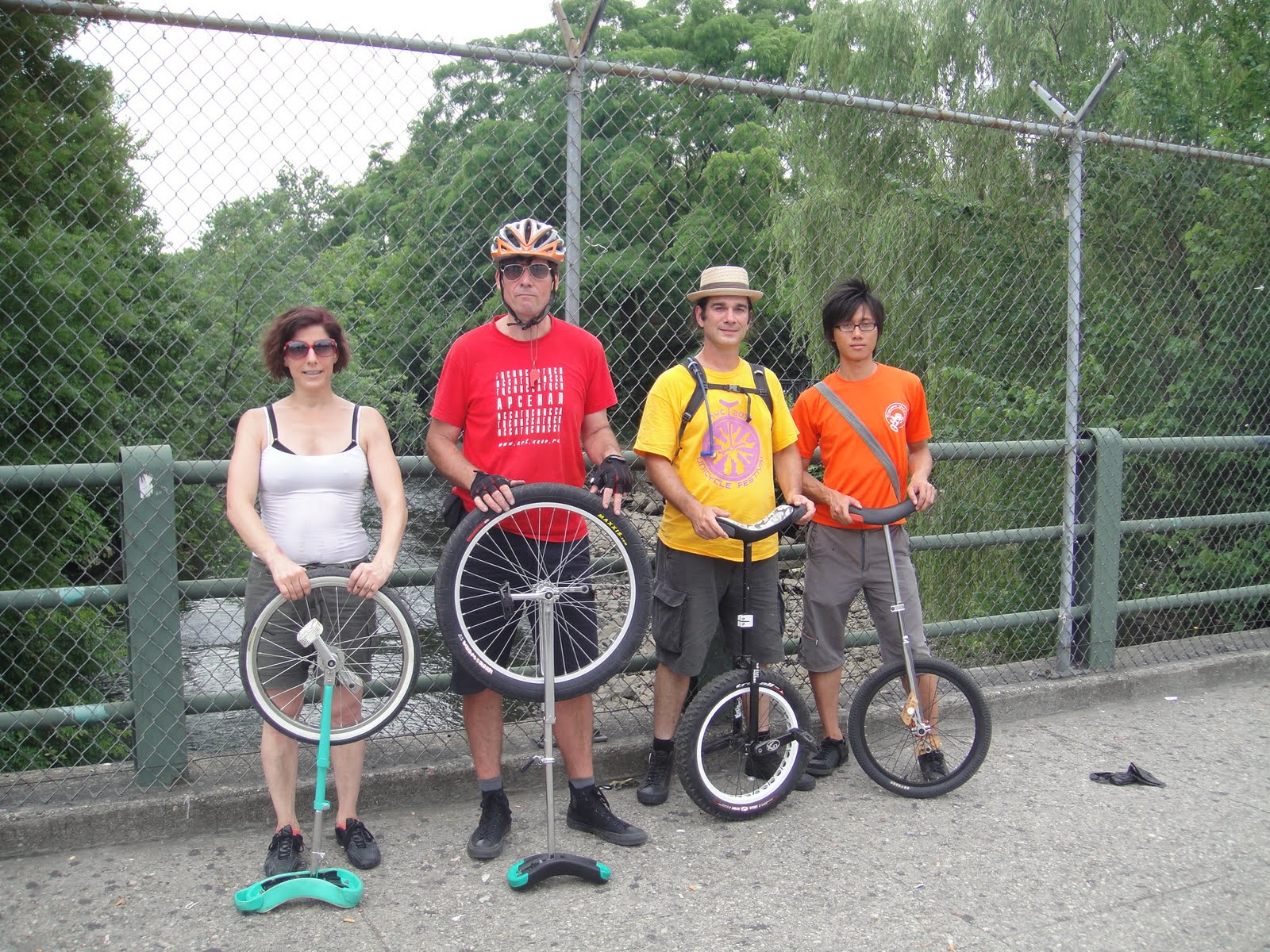
Shuan Sim, Viveca Gardiner, Rob Hickman, Keith Nelson

View on Unicycle NYC Bridge Tour Map at: unibridgetour.net

Started: Jun 22, 2010 11:47:58 AM
Ride Time: 1:58:40
Stopped Time: 0:00
Distance: 4.54 miles
Average: 2.29 miles/hr
Fastest Speed: 6.72 miles/hr

#153 East 177th Street Bridge over the Bronx River


East 177th Street Bridge over the Bronx River, Bronx, June 22, 2010
Viveca Gardiner, Keith Nelson, Shuan Sim, Rob Hickman

View on Unicycle NYC Bridge Tour Map at: unibridgetour.net

#152 East Tremont Ave. Bridge over the Bronx River


East Tremont Ave. Bridge (over Bronx River), Bronx, June 22, 2010
Viveca Gardiner, Rob Hickman, Keith Nelson, Shuan Sim

View on Unicycle NYC Bridge Tour Map at: unibridgetour.net

#151 East 174th Street Bridge over the Bronx River


East 174th Street Bridge (over Bronx River), Bronx, June 22, 2010
Shuan Sim, Viveca Gardiner, Keith Nelson, Rob Hickman

View on Unicycle NYC Bridge Tour Map at: unibridgetour.net

#150 East 174th Street Overpass over the Metro-North RR


East 174th Street Overpass over Metro-North RR, Bronx, June 22, 2010
Shuan Sim, Rob Hickman, Keith Nelson, Viveca Gardiner

View on Unicycle NYC Bridge Tour Map at: unibridgetour.net